
Local maker marketplace Design concept
Sanah
An Arabic Kuwaiti marketplace connecting craft products, preparation times and a practical seller order workspace.
We designed Sanah as a fictional collective of ceramic, textile and home-product makers in Shuwaikh and Salmiya. Customers should know who made an object, while makers should know what to prepare and when. The study joins a photographed marketplace with a seller portal for small batches and workshop collection.
Client in the design study
Sanah Local Collective
Shuwaikh and Salmiya, Kuwait
Project brief
A fictional maker marketplace and order workspace for small workshops managing preparation and collection.
Design scope
- Arabic identity and photographic product cards
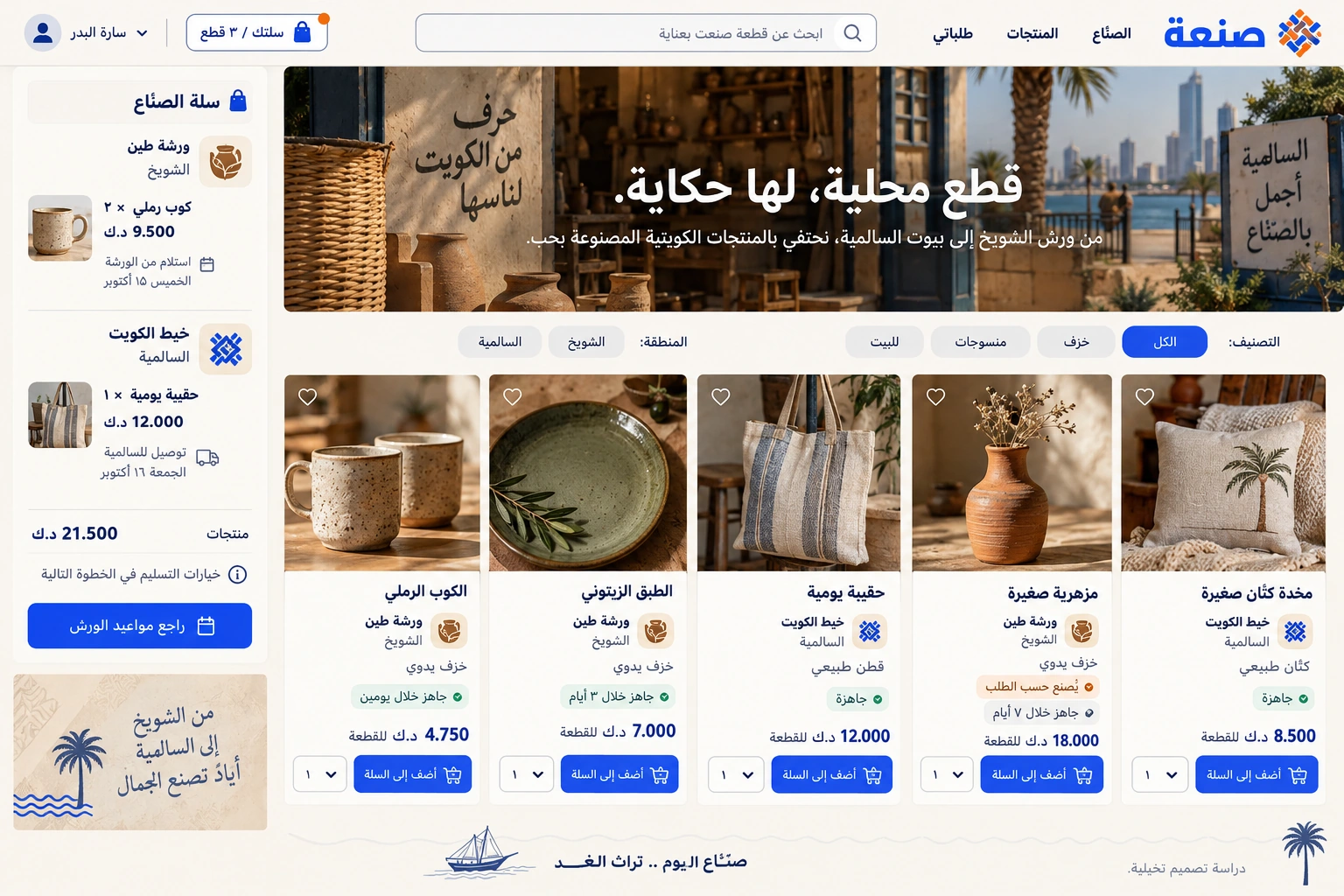
- Marketplace and workshop-grouped basket
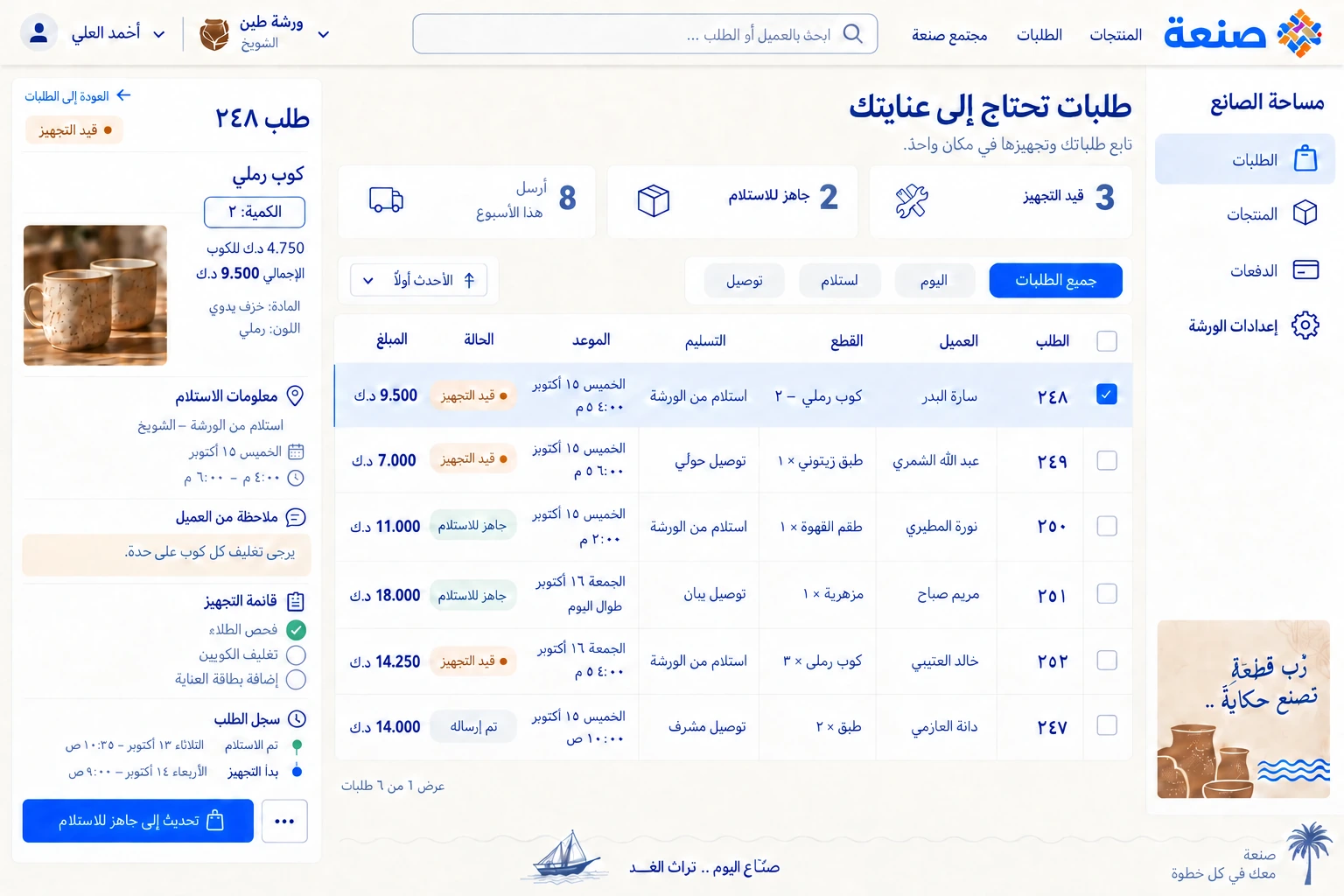
- Maker portal, order list and detail panel
01 / The project challenge
The project challenge
Makers handle products that may be made to order, while customers expect ordinary retail speed. In the scenario, dimensions, materials and preparation times were scattered across messages. A production order was hard to distinguish from a ready item. Products from two workshops could share a basket but not necessarily a date or delivery fee. The design needed workshop-level and order-level information rather than large colored cards and abstract counters.
02 / The solution we designed
The solution we designed
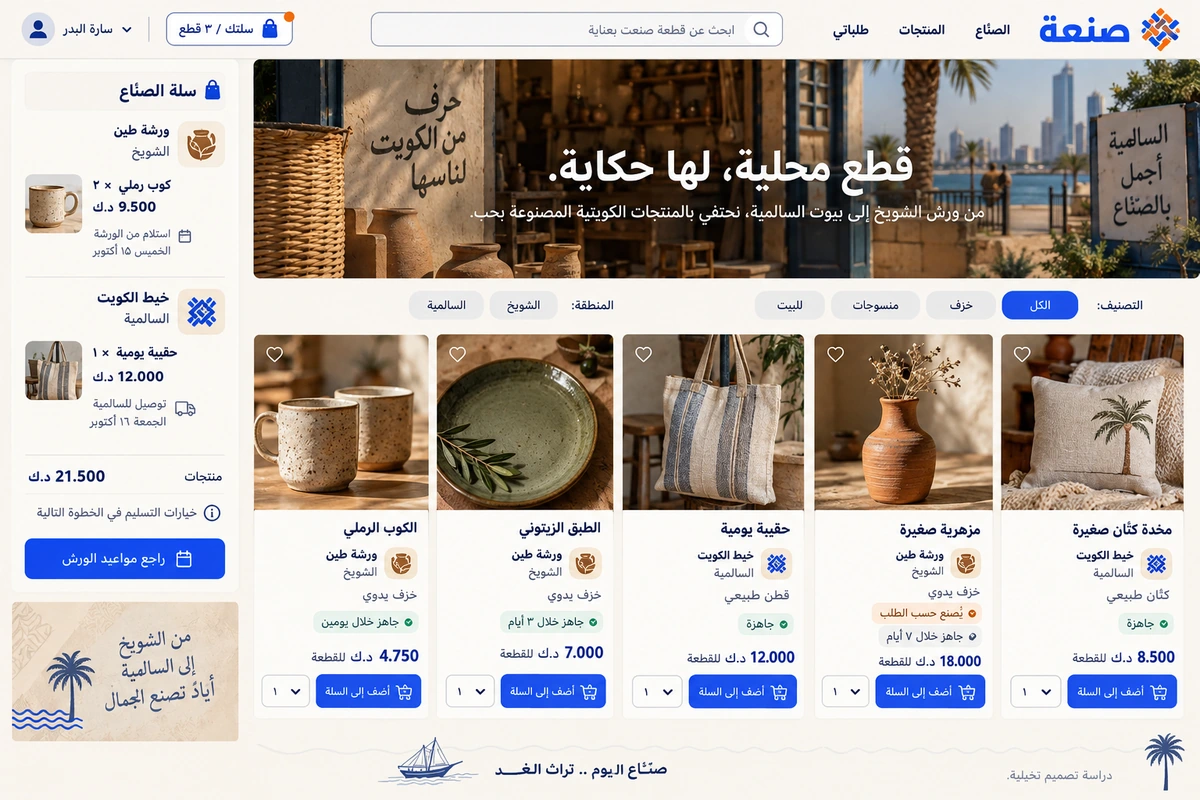
The marketplace displays real product photographs, concise material descriptions, prices, preparation times and maker names. The basket groups items by workshop, showing each collection option separately. The seller portal uses a compact, readable list with customer, order number, quantity, delivery method, deadline and state. A selected-order side panel exposes colors, customer notes and preparation steps before a maker updates the status.
03 / The experience
The experience
Sarah Al Bader selects two sand-colored mugs from a Shuwaikh ceramics workshop and a fabric bag from a Salmiya maker. The mugs cost 9.500 KD and the bag 12.000 KD, for a product total of 21.500 KD. Each workshop retains its own schedule. The ceramic maker opens order 248, sees the recipient and Thursday 15 October workshop collection, and moves it from preparing to ready only after adding that order’s packaging note.
04 / What it could do
What it could do
Products with makers
Each photograph, material and lead time is tied to its workshop and ready or made-to-order state.
Workshop baskets
Product values and collection choices remain separate for each maker instead of assuming one shared date.
Actionable orders
Customer, quantity, area, deadline and state let the maker prioritize work by delivery commitments.
Batch-specific details
Colors, personalization, packaging and status history are stored with each specific order.
05 / A typical journey
A typical journey
Discover makers
Browse a category and open the workshop to read materials and preparation times.
Collect choices
Add products to a basket organized by workshop, amount and schedule.
Confirm fulfillment
Review collection or delivery and add any requested customization.
Prepare and follow
The maker updates the order while the customer follows readiness and collection.
06 / Inside the interface
Inside the interface
Arabic interfaces with right-to-left reading and sample workflows set in Kuwait. Open the images to explore the details.
Explore the screens.
Open any screen to explore the complete project gallery.
07 / Design direction
Design direction
Sanah combines strong blue, warm orange and cream paper with a geometric Arabic wordmark inspired by hand making. Clear outlines and close product photography reveal clay and fabric textures. The maker portal keeps the same colors while prioritizing records and actions. Customer notes, quantities, dates and states vary meaningfully rather than repeating generic filler.
Discuss a similar idea